 PALO Framework
01 / Lifecycle Assessment
Frame the use case and build a control/evidence matrix across six lifecycle phases. Preserve unknown fields and identify the next review actions.
Development update / 30 October 2026 / Fabrizio Degni
Six workflows bring PALO reference materials into a conversational governance process: frame the case, design authority boundaries, inspect evidence and prepare documents for accountable review.
30 October 2026 / Evaluation update
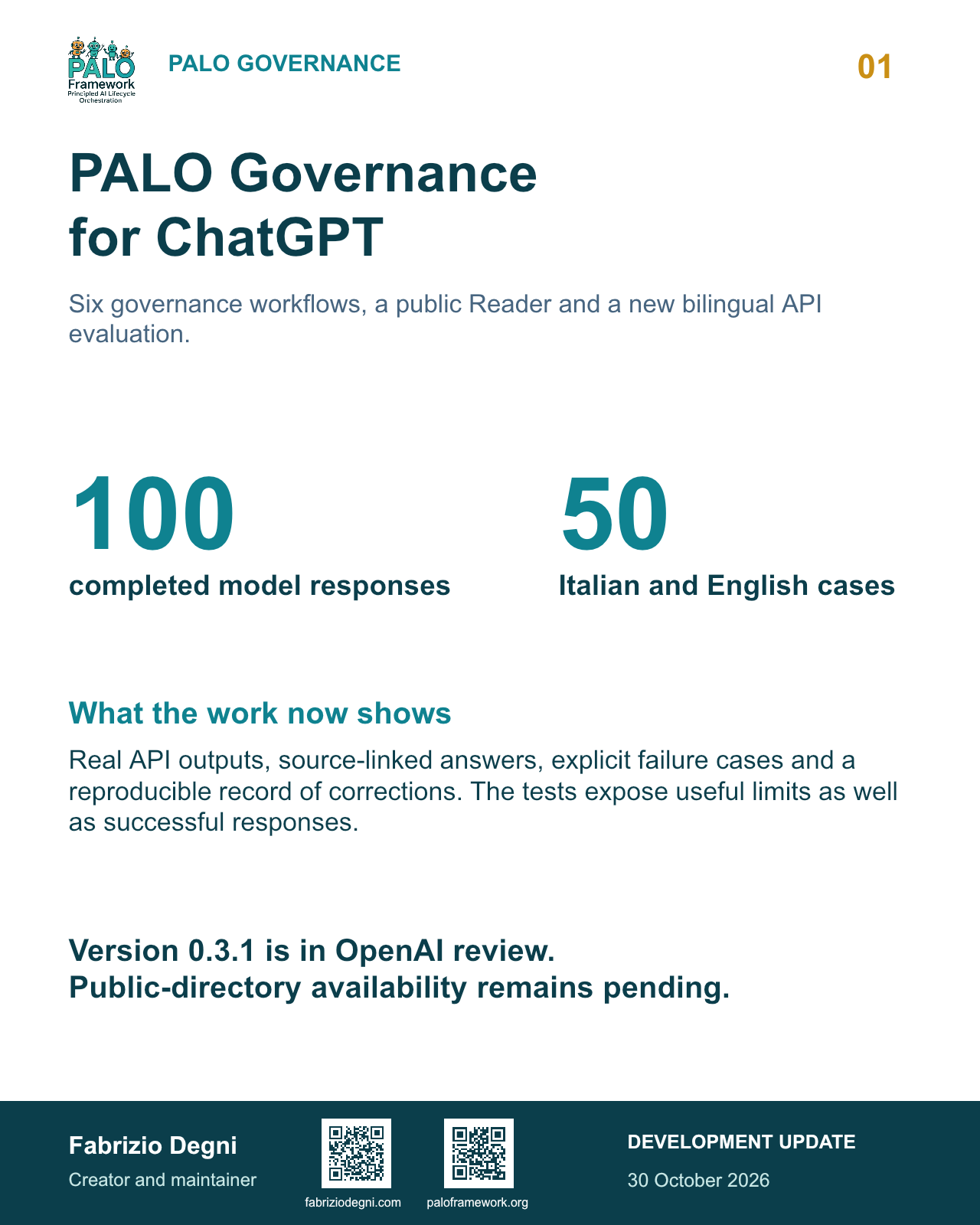
A new comparison covers 50 frozen Italian and English cases across all six workflows, using GPT-6.1 Sol and GPT-6 Luna. All 100 responses completed without API errors. The combined token-based cost estimate is USD 0.7069, with billing reconciliation still pending.
| Model | Responses | Original checks passed | Corrected checks passed | Estimated USD | Median seconds |
|---|---|---|---|---|---|
| GPT-6.1 Sol | 50 | 46 | 46 | 0.674682 | 12.05 |
| GPT-6 Luna | 50 | 40 | 44 | 0.032212 | 7.46 |
These are contract and citation checks, not overall accuracy scores. The corrected evaluator fixes four false positives on exact authority-boundary quotations. Original outputs remain preserved. One sample per case/model and fixed model order do not establish a general ranking.
An assistant reviewed 70 outputs, including every flagged answer and all sixteen answers to eight negative cases. The negative cases maintained authority and evidence boundaries. Three quotation-format failures, decision-label inconsistencies, preferred-reference coverage misses and two incorrect missing-reference reports still need attention. A revised instruction candidate is prepared, but has not been model-tested or deployed.

Read the complete English development and release report / Download aggregate results and limitations (JSON)
What changed
The new package organizes PALO into six autonomous skill directories. Each contains the same frozen snapshot of 26 canonical resources, including registries, schemas and synthetic examples. Version 0.2.0 introduced the protected OAuth Reader. The 0.3.0 candidate added a separate anonymous Reader for released canonical PALO references. Version 0.3.1, submitted on 29 October, uses that public endpoint under its own submission identity and preserves the same six skill trees.
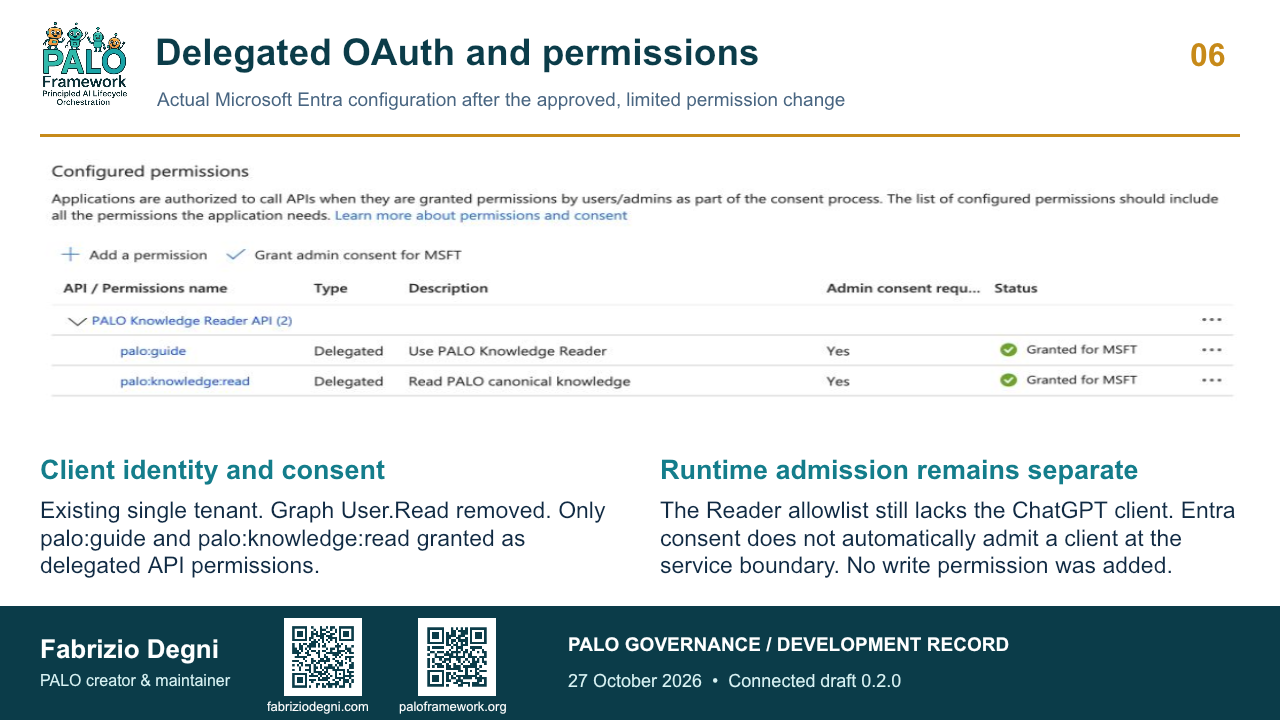
Work completed on 26 and 27 October included package validation, focused GLM and Gemini critiques, local host tests, Microsoft Entra permission configuration, a new OpenAI Platform draft, domain verification and a technical support escalation.
The 30 October update adds twelve English portrait slides with actual screenshots, an editable workflow, code, the bilingual API pilot and release steps. The new media kit includes PowerPoint, PDF, individual slide images, a technical report and LinkedIn copy. The earlier press backgrounder remains available as a dated archive.
This is an independent project by Fabrizio Degni. The plugin version is separate from PALO Framework and PALO-AI runtime versions. No OpenAI endorsement or production approval is claimed.
Explore PALO's agentic governance method or use the existing browser assessment tools.
The six modules
The skills produce drafts and identify missing evidence. Accountable people retain decisions, approvals and responsibility for the relevant systems.
Frame the use case and build a control/evidence matrix across six lifecycle phases. Preserve unknown fields and identify the next review actions.
Draft Action Claims and Effect Contracts for proposed actions. Define delegation limits, approval requirements, effect checks and negative tests.
Compare claims with supplied observations. Record contradictions, incident timelines and the tests needed to resolve uncertain outcomes.
Assess deployment capability and governance using the PALO two-lens rubric. Missing dates, evidence and required items remain visible.
Define indicators and reconcile costs against evidence. Keep uncertain billing, undefined ratios and local budget reservations distinct.
Document data flows, provenance, purpose and fitness requirements, disclosure constraints and evidence gaps.
The plugin does not execute business actions, grant authority, intercept other plugins or certify compliance. Its documentation rules do not substitute for deterministic access controls.
Implementation
The submitted public 0.3.1 package preserves the six skill trees, comprising 180 skill/reference files. Each skill includes 26 canonical resources. The separate protected 0.2.0 archive is retained as historical evidence.
SHA-256 of the submitted public 0.3.1 archive:deb2525b68ef2a93d18dd8dce812ad1391d54a3dc77e3569d2a2c7d44b8e477b
A hash identifies bytes. It does not establish factual correctness, authorization or successful runtime behavior.
palo-governance/
  plugin.json
  mcp.json
  assets/palo-logo.png
  skills/
    palo-agentic-action-design/
      SKILL.md
      references/
        operating-contract.md
        corpus/...
... five further skill foldersThe action-design skill routes uncertain past events to Evidence Review. Its contract separates four conclusions that need different evidence.
"For an actual timeout, incident or disputed past result,
start with PALO Evidence Review."

"Keep authorization, execution, observed effect
and business outcome separate."

"Never mint an executable claim, signature, token or approval."
Quoted from the packaged Agentic Action Design skill. Read the copyable excerpts and configuration notes.
29 October / Actual host evidence
In a private ChatGPT Work test with the same six packaged skill trees, five natural-language cases returned complete answers with source provenance: framework explanation, payment-pilot orientation, integration planning, source inventory and Italian retrieval. Requests to certify a company without evidence or execute a payment were refused. The private-data negative case was intercepted by a host safety filter and is not counted as passed.
Six separate calls through the public connector also returned valid results. These direct calls verify the connector, while the natural-language conversations verify visible host behavior; they are distinct evidence sets. Completed activity panels now load in the inspected cases, but a transient loading error was observed during generation. This does not establish that every rendering problem has been resolved.
Six additional workflow checks: a separate synthetic case for each skill now covers maturity, KPI/KRI and FinOps, evidence review, lifecycle, future-action design and data governance. The visible responses preserved missing evidence, uncertain costs, authority boundaries and disclosure limits. All 22 maturity items, 16 lifecycle control IDs and seven data-control IDs were checked against the packaged references. A transient loading message reappeared during the maturity case and disappeared before completion. These additional checks do not replace the host-filtered negative case or verify every raw tool argument. Read the English workflow test report and limitations.
Capture disclosure: 2 minutes 8 seconds, English captions and actual ChatGPT browser frames sampled at 2 fps. Cuts between segments are declared; no interface or result is fabricated. This is an edited development walkthrough, not a native continuous recording or proof of publication. Its URL is saved in the supporting review information for submitted version 0.3.1; the review outcome and acceptance of this evidence remain pending. The private test wrapper is version 1.1.0 and has the same 180 skill/reference files as submitted version 0.3.1. These remain distinct installations. Generated wrapper metadata is not the final public listing.
Download the captioned MP4 · Read the timestamped walkthrough and limitations
29 October / Activated and verified
The separate /mcp-public endpoint serves six read-only tools over seven released source collections containing 156 records. It requires no Microsoft login, OAuth token or publisher MFA. It cannot read private tenant records or execute business actions. The existing protected /mcp-guide service retains its tenant, permissions and MFA.
The VPS checks cover the six tools, provenance, invalid inputs, request limits, nonroot/read-only execution, network isolation and graceful restart. An actual authenticated call to the protected Reader also passed after the logging change. These checks establish the tested service behavior, not ChatGPT rendering stability or approval.
Reader and proxy logs now use a dedicated journal namespace. An hourly task rotates and expires archives older than 13 days, with volume limits and a local health check. The conditional operating target is 14 days while the clock, server and expiry process are healthy. An idle-socket defect found during cutover was corrected and retested. The 17 inventoried legacy nginx files were removed after explicit owner authorization. Provider backups remain a separate unresolved retention boundary; external alerting is not configured.
GLM 5.3 and Gemini 4 with high reasoning reviewed the implementation and follow-up corrections. Their textual reviews did not execute these tests or approve the release. The privacy notice and terms describe the active evaluation service and its limits.
Checks and limits
A corrected local Codex harness tested version 0.1.0 in an isolated directory. The failed case echoed an explicitly synthetic API placeholder; no real credential was supplied. The blocked case timed out during workspace routing before producing output. These outcomes do not qualify the connected 0.2.0 Reader or establish ChatGPT-host behavior.
GLM-5.3 High reviewed an extracted manifest, six skills and a shared contract. Gemini 4 with high reasoning reviewed three critical skills. Neither tested the installed runtime or reviewed the whole canonical corpus.
Accepted changes clarified resource isolation, full reference paths, routing and future versus observed evidence. A reported invisible-character defect was rejected after a byte check. Neither reviewer approved the final connected ZIP.
MCP and access
The release candidate uses the active anonymous public Reader. Tool arguments still leave the host over HTTPS, so use minimized, non-sensitive questions. The Entra-protected Reader remains separate for its existing authorized clients.
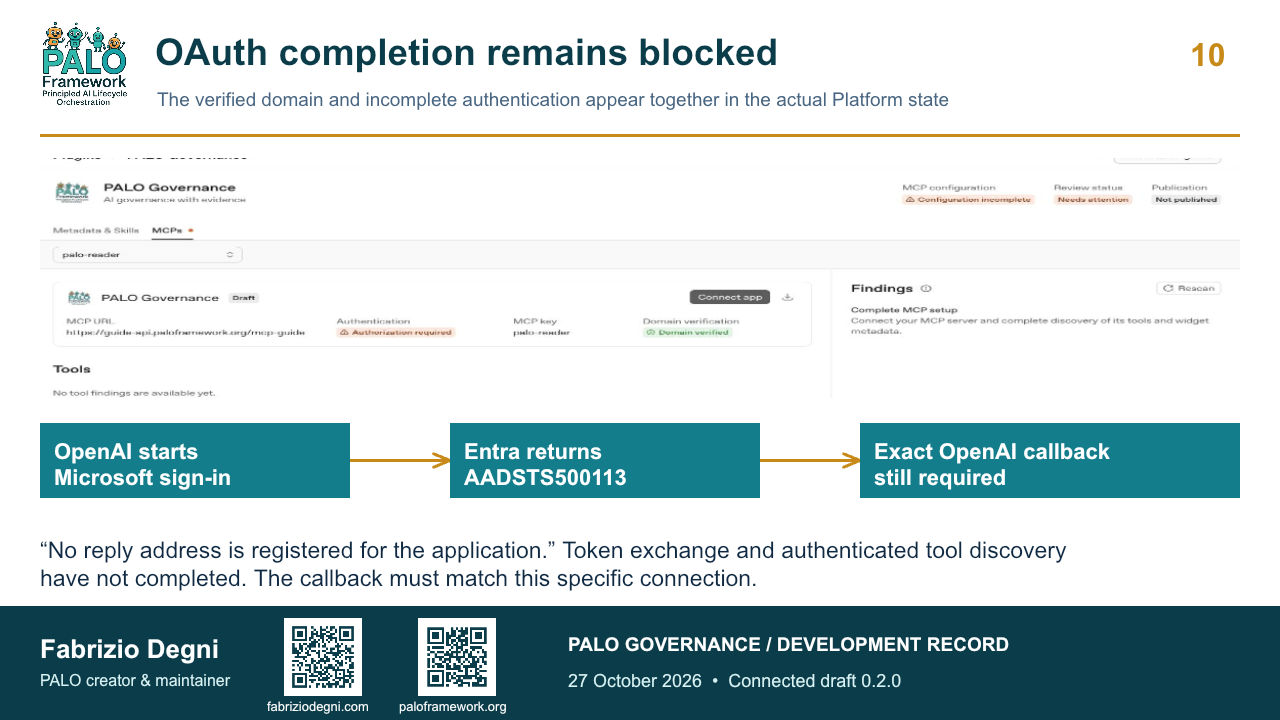
Selected fields from the actual 0.3.1 mcp.json, unchanged from the qualified 0.3.0 candidate. This endpoint has passed direct HTTPS qualification; version 0.3.1 has been submitted and is in review; publication remains pending.
"palo-reader": {
  "type": "streamable-http",
  "url": "https://guide-api.paloframework.org/mcp-public",
  "extensions": {"com.openai": {"auth": {"type": "none"}}}
}
Release record
| Area | Evidence date and observed state | Next evidence required |
|---|---|---|
| Package and skills | 0.3.1 submitted and in review; six unchanged workflows with updated access disclosures | Exact-version ChatGPT qualification |
| Public Reader | Active; six anonymous tools; 36 external HTTPS checks passed | Natural-prompt selection and stable host rendering |
| Protected Reader | Actual authenticated post-cutover call passed; access policy preserved | Continue separate operational monitoring |
| Retention | Hourly age expiry and local health checks active; 17 inventoried legacy logs retired | Provider backup/deletion and contractual answers; external alerting remains unconfigured |
| Privacy and terms | Version 1.1 describes the active evaluation service and remaining limits | Complete provider-specific verification before public release |
| Reviewer materials | Anonymous access active; five positive and two negative host cases passed; one host-filtered case unassessed; real walkthrough supplied | Resolve unassessed case and confirm exact saved-version host qualification |
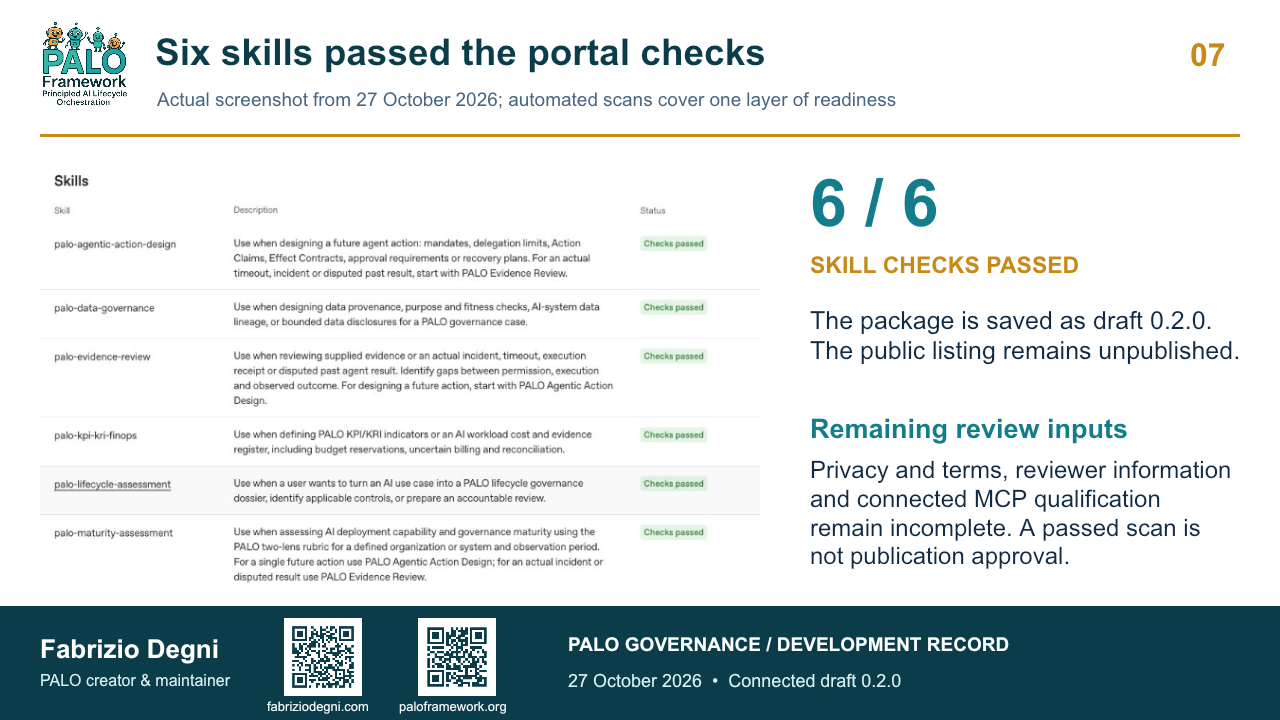
| OpenAI Platform | Submitted public version 0.3.1 and its MCP integration both In review; Configured, No authentication, Domain verified; six tools and no MCP scan findings; all six skill checks passed and no metadata findings | Await review feedback and decision; keep the reviewer endpoint and evidence available |
| Public listing | Submitted and In review; not approved or published | Address review feedback; publish only after approval |
The all-countries preference is a submission setting, not evidence of public listing availability. Service tests, host tests and portal review establish different things.
28 October / Reviewer connection
Fourteen authenticated calls explicitly used the dedicated reviewer connection and covered five service workflows across all six Reader tools. The checks verified the six-phase explanation, a route hypothesis, remote integration planning, seven source entries describing 156 canonical records, exact-record retrieval and expected rejection of a nonexistent record.
The Italian query returned no matches; an English reformulation returned the cited provenance and human-review records. This fallback is retained in the evidence. Successful service calls do not establish autonomous ChatGPT tool selection or working access for an external reviewer.
Earlier protected-Reader rehearsals encountered response-display failures in expanded ChatGPT activities. Later final answers were readable, but complete trace rendering was not qualified. This paragraph records the earlier protected-Reader checks. The public-Reader host results and recorded walkthrough are documented above. The historical 0.2.1 protected draft remains separate from submitted public version 0.3.1; both have populated website, support, privacy and terms metadata.
28 October / Authenticated service results
Fourteen calls cover five service workflows and a missing-record check. The English walkthrough shows returned sources, the Italian-to-English search fallback and explicit authority limits.
Watch the 2:30 evidence walkthrough
This is a labelled visualization of publisher-account service results, not a ChatGPT screen recording or independent reviewer qualification. The subsequent actual ChatGPT development walkthrough is embedded above and linked in submitted version 0.3.1; its acceptance remains subject to review.
Updated 30 October 2026 / English publication materials
Twelve portrait slides document the public Reader, all six workflows, actual OpenAI Platform captures, the bilingual API pilot, evaluator corrections, code and remaining release steps. The PALO logo and two verified website QR codes appear consistently throughout. Version 0.3.1 remains in review and is not yet publicly listed.
The ZIP contains the PDF, editable PowerPoint, twelve individual slide images, the report, results and post copy. The PDF is a visual edition; the report and PowerPoint provide text access. Source notes are included in the presentation.
Public downloads exclude credentials, private account identifiers and personal telephone details. Publication of these files does not mean a LinkedIn post or media outreach has been sent.
This earlier snapshot predates the public Reader activation and the API pilot. Its status statements describe that date.
Suggested media description: PALO Governance is an independently developed ChatGPT plugin candidate for preparing AI governance documentation with traceable references and explicit evidence gaps.
Not yet. PALO Governance 0.3.1 was submitted on 29 October 2026 and is in OpenAI review. Approval and public-directory publication have not occurred. The separate public Reader and existing PALO website tools remain available through their documented routes.
No. It prepares and reviews documentation. Operational authority, protected execution and effect verification require separate controls and evidence at the actual integration boundary.
Depending on the tool, its arguments may include a query, use-case description, product or deployment information, objectives or a source record identifier. Use minimized questions without credentials or raw sensitive case material. Host processing and PALO Reader processing have distinct roles. Microsoft identity applies only to the separate protected Reader. Read the connected-service privacy notice for the current evaluation setup and the remaining retention and provider checks.
They supplied textual critiques within explicit scopes. The coordinator checked findings against the actual files and PALO method, accepted supported improvements and rejected an unsupported byte-level claim. Reviews do not establish runtime security or OpenAI approval.
See OpenAI's plugin submission guide and authentication documentation. These explain the platform process; this page documents the separate PALO implementation.
Publisher and support
PALO Framework creator and maintainer. For plugin questions, error reports and privacy or deletion requests, contact info@paloframework.org. Include the version and a minimized example, without credentials or confidential case files.
Professional profile and media contact / PALO community and support routes / Existing website privacy notice
The connected Reader privacy notice and terms of use are now published for the evaluation service. They describe current limitations and do not imply approval or public-release readiness.