Documentation review. No model inference benchmark or production integration is claimed.
What is a decision model?
A decision model maps a supplied state and predefined questions to typed judgments, such as a probability, a selected option or a rating. It is useful when software needs a constrained semantic assessment rather than a paragraph. Many implementations avoid autoregressive text decoding; the exact inference path depends on the model and release.
Typical tasks include intent classification, model and tool routing, rubric scoring, moderation triage and checking whether retrieved evidence supports a claim. The term System One is an engineering analogy, not a formal safety category. A valid output schema does not establish a correct answer, and a probability does not grant permission to act.
Common interfaces; providers use different schemas
Primitive
Useful for
Boundary
Binary predicate / noul
Whether a stated condition is supported
Probability of a proposition; not an authorization flag
Choice
One label among supplied options
Include an explicit insufficient-evidence option
Score
An ordered rubric
A rating is not necessarily a probability
Locate, extract, box, track
Text spans or spatial targets
Model-specific extensions; not universal capabilities
The OpenAI Decisions guide uses input and named questions including predicate. Do not assume that changing only the base URL makes all providers interchangeable.
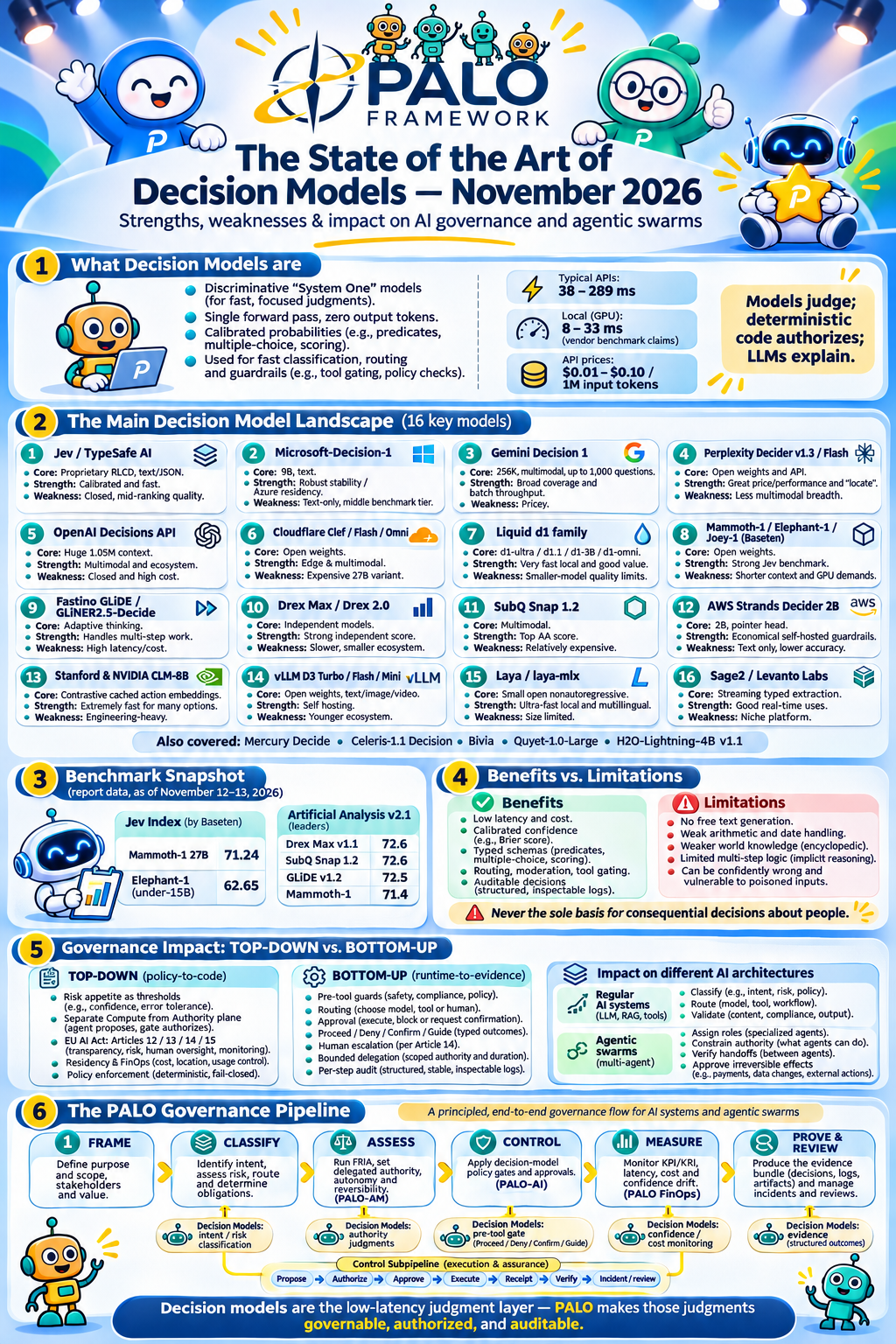
The November 2026 infographic
The supplied infographic is preserved as a dated visual overview. Its numerical ranges and rankings describe the source snapshot, not a fresh PALO benchmark. The following notes take precedence when interpreting it.
Supplied artwork. Open the full-resolution PNG for details. Text explanations, access links and corrections are available on this page.
Corrections and reading notes
GLiDE releases: adaptive thinking describes the original GLiDE. The v1.2 training report describes reasoning distilled into direct predictions. Its API cost cannot be explained simply as billed adaptive thinking.
Question batching: the Decider v1.3 model card distinguishes separate and isolated question modes. Batching can change answers; additional questions are not automatically behavior-preserving.
Calibration: training for calibration does not guarantee calibration on your domain. Measure reliability on representative held-out traffic.
Performance and price: cloud end-to-end latency, local GPU inference, input-token prices and benchmark task costs are different measures. The graphic omits higher-priced variants and should not be used as a universal range.
PALO sequence: approval applies when required. The full assurance path also includes a scoped capability and observed effects; a receipt alone does not prove success.
Current access: the Inception documentation announces that its API remains available through 28 December 2026 and then closes. This changes the suitability of Mercury Decide for new integrations.
Decision model census and access routes
This curated inventory covers the 16 main families and five additional leads named in the supplied research. It is not an exhaustive count of every checkpoint, quantization or benchmark submission. All 21 entries now have an inspected primary source. Documentation checks do not establish API access for your account, inference quality or production readiness.
21 catalogue entries
Curated inventory reviewed on 15 November 2026; no PALO inference tests performed
Download the JSON inventory · Download the CSV inventory. Pin exact versions, review the license for the actual weights, and check data retention, deployment region and rate limits. Downloadable weights do not make operation free or prove data sovereignty.
How to read the benchmark snapshot
The infographic places the Hugging Face Jev Decision Index next to Artificial Analysis. Those scores belong to different suites and versions. They are not directly interchangeable, and they do not establish performance on a business workflow.
A Nace.AI comparison dated 13 November 2026, reporting Artificial Analysis v2.1, lists Drex Max v1.1 and SubQ Snap 1.2 at 72.6 after rounding, followed by GLiDE v1.2 at 72.5. These are vendor-reproduced third-party figures; PALO has not independently rerun the suite. The Artificial Analysis evaluation overview and methodology were inspected directly. They describe the suite, but the interactive ranking values were not captured directly in this review.
The Hugging Face board is available as an interactive Space; its rendered scores were not captured in this review. The artwork's Mammoth and Elephant figures are retained as historical supplied values, not recertified current rankings. A claim of 301 models is therefore not presented as a verified market count.
Artificial Analysis v2.1 combines AA-Paperclip (30%), EvalSafe-O*NET-AA (15%), When2Call (10%), AA-Omniscience-Decision v1.1 (15%), HLE-MultiChoice v1.1 (15%) and AA-Symmetry v1.1 (15%). The composite combines answer quality and probability scoring, with a separate invariance metric for symmetry; it is not a simple accuracy percentage.
For procurement, compare the same model release, endpoint, input length, hardware, batch size and evaluation suite. Record accuracy, Brier score, calibration error, false negatives, abstention, p50/p95 latency and full task cost. A dollar-per-million-task figure depends on the suite's prompts; it is not a price per million input tokens.
Where decision models fit in PALO
PALO keeps model inference in the compute plane and permission checks at the authority boundary. A model may identify a possible policy issue or suggest a route. Deterministic controls check the actual mandate, identities, scope, current state, budget and required approval before a tool can act.
ProposeAuthorizeApprove when requiredIssue scoped capabilityExecuteReceiptObserveVerifyEscalate when required
This is the assurance sequence documented in the PALO taxonomy. It complements the canonical lifecycle: Frame → Classify → Assess → Control → Measure → Prove. The infographic's “Prove & Review” is an explanatory label; the canonical phase name is Prove.
Suggested integration roles; these are design patterns, not implemented integrations
Phase
Possible model contribution
Accountable control
Frame
Identify the stated purpose and ambiguous intent
Owner defines scope, affected people and alternatives
Classify
Suggest a risk or routing label
Validate applicability; a model label is not a legal classification
Assess
Flag possible misuse, sensitive data or harmful effects
Assess fundamental rights, reversibility and oversight
Control
Supply bounded evidence for a pre-tool gate
Enforce scope, approval, fail-closed behavior and revocation
Measure
Track judgment outcomes and confidence drift
Own KPI/KRI thresholds and full cost reconciliation
Prove
Provide typed judgments for a structured audit record
Preserve provenance, observe effects and review unresolved outcomes
Top-down policy and bottom-up evidence
Top-down design translates risk appetite and obligations into owned controls, acceptable error costs and escalation conditions. Bottom-up evidence records which model version saw which minimal state, what it returned, which rule authorized the exact action and what happened afterwards. A score cannot replace that chain.
Regular systems and agentic swarms
For a classifier, RAG pipeline or tool workflow, use the model to triage, rerank or flag uncertainty. In a swarm, also bind each agent's role, delegation scope, handoffs and authority duration. Multiple agreeing agents do not acquire additional permission, and correlated errors should not be treated as independent votes.
Typed outputs that software can validate directly.
Lower inference latency for bounded semantic tasks.
Explicit uncertainty for triage and escalation.
Smaller local checkpoints for selected workloads.
Structured evidence of the model's judgment.
Material limitations
Closed-set answers can still be confidently wrong.
Calibration can shift with language, context and domain.
Arithmetic, dates and exact rules belong in code.
Poisoned input can affect a validly formatted answer.
A plausible explanation does not prove why the model chose an option.
Consequential decisions: preserve applicable legal safeguards and meaningful human oversight. Do not use a model score as the sole basis for a consequential decision about a person. A deterministic gate also needs correct policy inputs and cannot by itself establish compliance.
EU AI Act context
The supplied research maps logging, transparency, oversight and robustness to Articles 12–15. Treat that as a control-design discussion: applicability depends on the system's classification, role and legal context. A model, a probability threshold or this PALO mapping does not certify compliance with Regulation (EU) 2024/1689. Use the risk screening and impact assessment as accountable starting points.
A practical pilot
Choose one bounded judgment. Separate semantic interpretation from calculations and authorization.
Prepare minimal state and representative cases. Include rare harms, ambiguous inputs, languages and abstention cases. A few hundred examples are only a starting point; justify the sample against the risk.
Evaluate on held-out data. Measure discrimination and calibration, per-group failures, option-order sensitivity and adversarial inputs.
Choose escalation thresholds. Use asymmetric error costs and an explicit insufficient-evidence route. High confidence never overrides required approval.
Run in shadow mode. Compare with the existing workflow before enabling effects. Define acceptance criteria and a stop condition; no fixed number of weeks proves safety.
Operate with versioned contracts. Pin model, policy and adapter versions; record hashes, decisions, costs and effect observations with purpose-limited retention and access controls.
Costs and self-hosting
Calculate API input cost as billed input tokens divided by one million, multiplied by the current input rate, then add retries, other charged modalities, infrastructure and human review. For self-hosting include capacity, utilization, engineering, energy and incident handling. At an illustrative $0.042 per million tokens and 1,000 tokens per request, a $1,380 monthly server equals about 32.9 million requests per 30-day month before these other costs. That arithmetic does not prove the server can serve the workload or produce savings.
Frequently asked questions
Can a decision model authorize an agent action?
No. It can provide a semantic judgment used by a policy evaluation. Permission must come from a valid mandate and enforceable controls for the exact action.
Does zero output tokens mean zero hallucinations?
No. Avoiding free-form generation can constrain the output shape. The model can still choose a wrong option with high confidence.
Are probabilities automatically calibrated for my organization?
No. Check reliability on held-out data from the intended workflow, including important subgroups and changed inputs.
Are the listed models available and production-tested by PALO?
No. All entries link to inspected primary documentation; exact sibling releases and deployment access still need qualification. PALO has not run inference or qualified deployment, residency or operating effectiveness for this publication.
Is this page a replacement for PALO's governance model?
No. It adds a research perspective on a possible judgment layer while preserving the established lifecycle, authority boundaries and evidence contracts.
Sources and review provenance
Written and maintained by Fabrizio Degni. Published as an English editorial adaptation of the supplied Italian research and infographic, with primary-source checks dated 15 November 2026. Model-specific primary sources appear in the inventory and near the associated claims.
The author’s 15 November LinkedIn discussion and source series connects top-down governance intent with bottom-up operational evidence. This article incorporates source references from parts 1–3 and follows the canonical PALO terminology where the social post and infographic use abbreviated labels.
 PALO FRAMEWORK